Knowing which rodent you have changes the whole plan
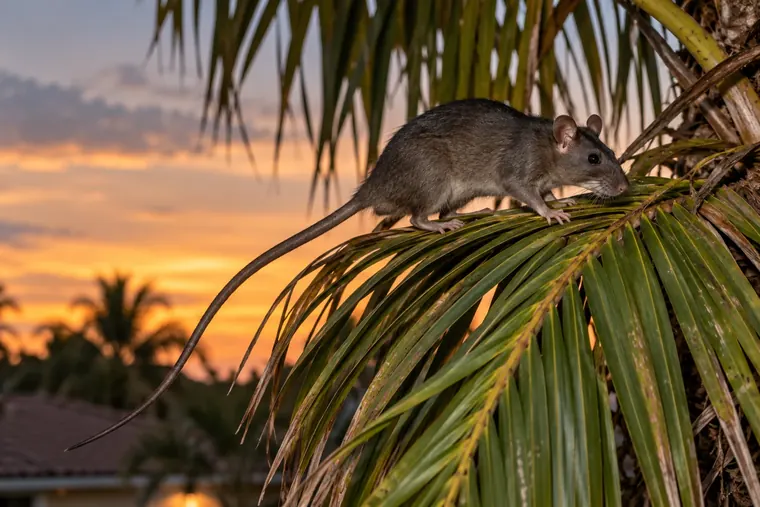
UF/IFAS identifies the roof rat as the most abundant and most destructive rodent pest in the state of Florida. It is the species that takes up residence in attics, soffits, hollow walls, and outbuildings, and it thrives in palms and ornamental shrubbery. Crucially, it is a climber that prefers to nest off the ground.
That single behavioral fact separates it from the Norway rat, which is a burrower that favours ground level, foundations, slab edges, and sewer lines, and nests low rather than high. It also separates it from the house mouse, which is much smaller, ranges over a shorter distance, and can exploit far smaller openings. If a provider treats every rodent call the same way, the plan is being applied rather than designed.
| Species | Typical nesting location | Where to inspect first |
|---|---|---|
| Roof rat | Above ground: attics, soffits, wall voids, palms, dense shrubs | Roofline, soffit returns, gable vents, overhanging limbs, utility lines |
| Norway rat | Ground level: burrows, foundations, under slabs and decks | Foundation perimeter, slab penetrations, crawlspace, drain lines |
| House mouse | Close to a food source: wall voids, cabinets, appliance cavities | Kitchen and pantry voids, garage, utility penetrations near grade |
Roof rat routes on Merritt Island properties
A roof rat does not usually walk up a wall. It arrives along something. UF/IFAS notes that roof rats routinely use utility lines and tree branches to reach food and water and to enter buildings, and on Merritt Island the mature oak and palm canopy supplies an unusual density of those connections. A limb that clears the roof by a few feet, a vine on a trellis, a fence top that runs to a corner of the house, and the service drop to the building are all functional bridges.
This is why an inspection that never leaves the interior cannot succeed. The interior tells you an animal is present and roughly where it travels. The exterior tells you how it arrives and where it gets in. Both are needed, and if the exterior assessment is not explicitly in the scope, ask why not.
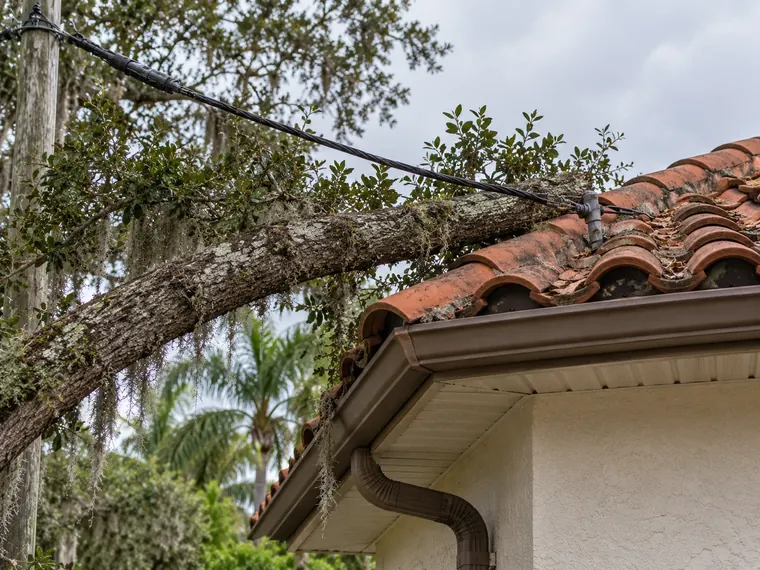
Palms deserve specific attention. Untrimmed fronds and accumulated boots create sheltered, elevated harbourage directly adjacent to many Merritt Island rooflines, and a palm in that condition is effectively a nest site with a walkway attached. Fruit trees do the same job from the food side: UF/IFAS publishes guidance specifically on controlling roof rats in fruit trees, which reflects how reliably citrus and other backyard fruit sustain local populations.
Why the pressure does not stop in winter
In much of the country, rodent problems have a pronounced season. Florida's mild winters remove that pause. Breeding and foraging continue through the year, so a property is not waiting for an annual invasion; it is sitting in continuous low-level pressure that rises whenever conditions change.
Two local patterns shift that baseline. Cooler nights raise the appeal of a warm, dry attic, which is why calls often increase when temperatures drop even though the population has not grown. And during the June-to-November storm season, saturated ground displaces rodents from low outdoor harbourage toward higher, drier shelter. On terrain as flat as Merritt Island, the nearest higher, drier structure is frequently a house.
Landscape changes that support roof rat control in Merritt Island
Habitat management is one of the core components of integrated pest management as UF/IFAS describes it, alongside inspection, physical control through trapping and exclusion, and chemical control where warranted. In practice, for a roof rat, it means removing bridges and removing meals.
- Keep limbs from touching or overhanging the roof where it is safe and lawful to do so, and maintain that clearance rather than treating it as a one-off job.
- Have palms maintained so fronds and boots do not form sheltered harbourage next to the roofline.
- Thin dense ornamental planting directly against exterior walls so the wall surface and its penetrations remain visible and inspectable.
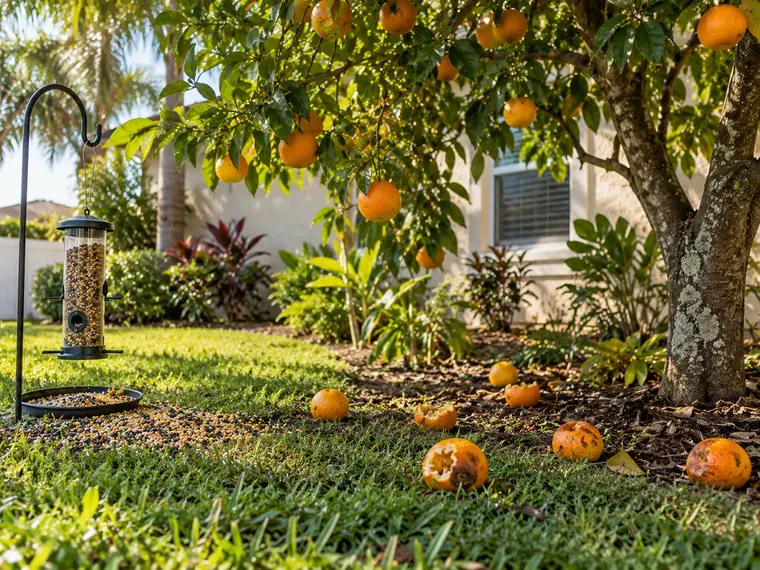
- Pick up fallen fruit promptly and harvest ripening fruit rather than leaving it on the tree through the season.
- Clean up spilled bird seed, and store seed and pet food in sealed hard containers rather than bags.
- Address leaking irrigation and standing water near the foundation, which supply the water half of the equation.
Do not undertake work near electrical service lines, and do not work from a roof yourself. Where trimming would involve either, use a qualified tree service. Habitat work reduces pressure, but it does not evict animals already inside, and it does not close the opening they are using. It works alongside exclusion, not instead of it.
Before agreeing to outdoor bait, ask about what else eats rodents
UF/IFAS notes that second-generation anticoagulant rodenticides, including brodifacoum, bromadiolone, difenacoum, and difethialone, can kill after a single night's feeding and remain in animal tissue longer than first-generation products. Animals that feed on affected rodents, including cats, dogs, owls, eagles, and hawks, can be poisoned as a result. Merritt Island has substantial raptor habitat and protected land nearby, which makes this a practical local question rather than an abstract one. Ask which product is proposed, where stations would be placed, how they are secured, and whether trapping combined with exclusion can achieve the same outcome.
Effective roof rat control in Merritt Island, in sequence
The order matters more than any single technique. An inspection establishes what is active, where the travel routes run, and which openings are usable. Habitat and sanitation changes lower the property's attractiveness. Trapping addresses the animals currently present, with placement based on the routes the inspection identified rather than on convenience. Verification confirms activity has stopped. Exclusion then closes the openings permanently, using materials of an appropriate specification.
Reversing those steps causes the failures people describe as the problem coming back. Sealing before removal traps animals inside, where they die in voids and insulation. Trapping without exclusion clears the current occupants and leaves the route open for the next ones. Baiting without inspection may reduce numbers temporarily while telling you nothing about how they are getting in.
For roof rat control Merritt Island homes can rely on, ask for the plan in that sequence, with the verification step named explicitly, and ask what evidence will be used to decide that the structure is ready to be closed up.
One further point specific to roof rats: because they range across connected properties rather than staying within a single lot, a neighboring untrimmed palm, an unharvested fruit tree, or an unsecured bin next door can sustain pressure on your house after your own property has been dealt with correctly. That does not change what you should do, but it does explain why a well-executed job sometimes still needs periodic re-inspection, and why keeping the structure sealed matters more than keeping the neighborhood rodent-free, which is not achievable.
Frequently asked questions
Why are roof rats so common in Florida?
UF/IFAS identifies the roof rat as the state's most abundant and destructive rodent pest. It climbs well and nests above ground, and Florida's mild climate, dense ornamental landscaping, palms, and backyard fruit provide year-round shelter and food.
Will trimming trees solve the problem on its own?
No. Trimming removes an approach route and lowers pressure, which is worth doing, but it does not remove animals already inside or close the opening they are using. It is one component of an integrated approach.
Can roof rats really use a utility line?
Yes. UF/IFAS specifically notes that roof rats use utility lines and tree branches to reach buildings. This is why an exterior inspection needs to consider the service drop and any cable or line reaching the structure, not just vegetation.
Should the attic be treated if the rats are getting in from a tree?
Those are two parts of one job. The tree is the approach, the attic is the destination, and somewhere between them is an opening. Addressing the approach without closing the opening leaves the route usable from any other bridge that develops later.
Roof rat behavior, habitat, and integrated pest management context on this page draw on UF/IFAS extension material on rat and mouse control and on roof rats in fruit trees. Rodenticide and secondary poisoning information draws on UF/IFAS material on rodenticides. This page is general information, not a diagnosis of conditions at any specific property.