What a real Merritt Island rodent inspection covers
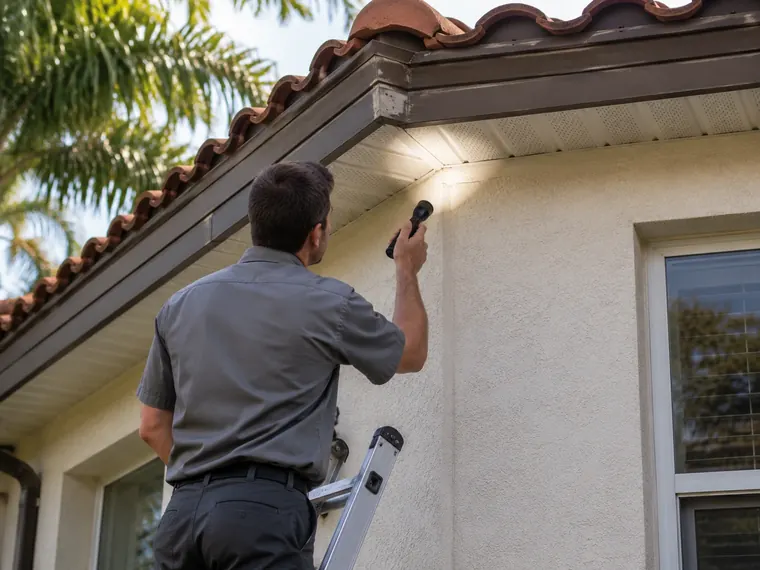
The inspection determines everything downstream, and it is the step most often shortened. A useful one answers three questions: what is active now, where is the animal traveling, and how is it getting in. Answering the third requires going outside.
Inside, the inspector should be looking for droppings and their distribution, rub marks along travel routes, gnawing and its freshness, nesting material, and evidence in the attic or accessible voids. Outside, the work is the roofline, soffit returns, the soffit-to-fascia junction, gable and ridge vents and their screening, tile ends at eaves and rakes, utility and line-set penetrations, the garage door seal and corners, and the landscape approach routes: overhanging limbs, vines, fence lines, palms, and the service drop.
If the proposal that comes back describes only interior work and bait placement, the exterior assessment did not happen or did not inform the plan. That is the moment to ask, before anything is scheduled. The rodent inspection page sets out a full checklist.
Questions worth asking on the first call
- Does the inspection include the exterior envelope and roofline, or interior only?
- What is your license number, and is the business licensed with FDACS?
- What is the proposed sequence, and at what point are openings closed?
- How do you verify activity has stopped before sealing?
- Are exclusion, contaminated material removal, and insulation replacement included or quoted separately?
- What did you find that falls outside your scope, and who handles it?
- What follow-up is included, for how long, and what would void it?
How Florida regulates rodent control services
Structural pest control in Florida is regulated by the Florida Department of Agriculture and Consumer Services. FDACS licenses pest control businesses, certifies applicators, and conducts inspections and investigations in the industry. For a homeowner, the practical consequences are straightforward.
Active pest control companies hold a numbered state business license issued annually, and those business license numbers carry a JB prefix. FDACS publishes a public license search, and it will confirm whether a company or an individual is licensed by phone at 850-617-7997 during weekday business hours. You can also ask a company directly for a copy of its license.
Checking takes a couple of minutes and is worth doing before work is scheduled rather than after a dispute. A provider that cannot or will not supply a license number has given you a clear signal. Note also that licensing covers pest control work specifically; structural repair to fascia, soffit, decking, ductwork, or wiring may require a different licensed trade, which is a distinction worth clarifying while you have someone on the phone.
Rodenticides, bait stations, and label law
Chemical control is one component of integrated pest management as UF/IFAS describes it, sitting after inspection, habitat and sanitation work, and physical control through trapping and exclusion. It is not the default opening move, and on a property where exclusion has not been addressed it rarely resolves anything durably.
Where rodenticides are used, the differences between products matter. UF/IFAS distinguishes first-generation anticoagulants, including chlorophacinone, diphacinone, and warfarin, which require feeding over multiple days, from second-generation anticoagulants, including brodifacoum, bromadiolone, difenacoum, and difethialone, which can kill after a single night's feeding and remain in animal tissue longer. That persistence is what creates secondary poisoning risk: animals that feed on affected rodents, including cats, dogs, owls, eagles, and hawks, can be poisoned in turn.
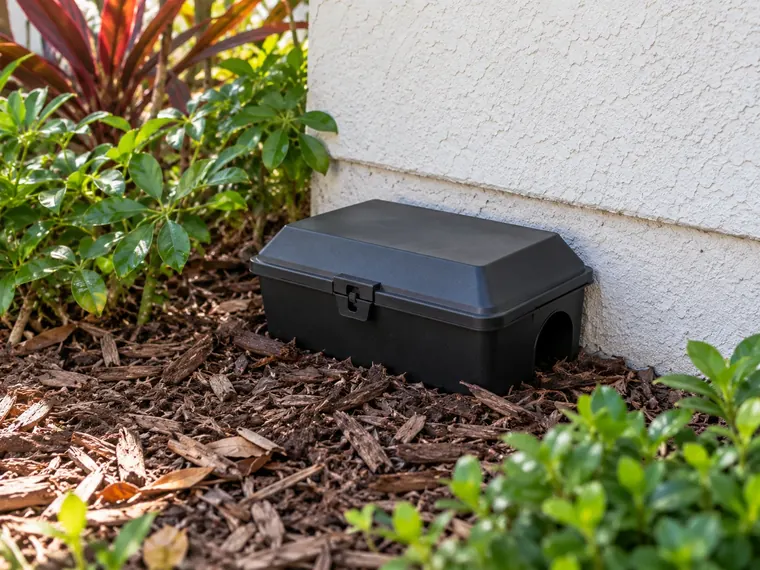
Consumer products are required to be used in tamper-resistant stations, and UF/IFAS notes that ready-to-use stations are tiered by level of protection, with Tier 1 stations usable by homeowners within 50 feet of buildings. It also notes that pelleted and powdered bait formulations have a higher potential to be shaken out, washed out, or relocated by rodents from stations, which is a practical argument for block formulations in secured stations where bait is used at all. Pesticide labels carry the force of law, and following label directions is not optional.
Given the protected land and raptor habitat around Merritt Island, it is entirely reasonable to ask whether the result can be achieved with trapping and exclusion, and to ask what product is proposed, where stations would sit, and how they are secured against children and pets.
The sequence, and what each phase costs you if skipped
| Phase | What it establishes | If it is skipped |
|---|---|---|
| Inspection | Species, activity level, travel routes, entry points | The plan addresses symptoms without locating the route |
| Habitat and sanitation | Reduced food, water, and approach routes | Pressure stays high and reinfestation is faster |
| Removal | Current animals addressed, placement based on routes | Animals remain and are sealed in during exclusion |
| Verification | Confirmation that activity has stopped | Openings closed too early; carcasses in voids and odor |
| Exclusion | Routes closed with specified materials | The next population uses the same opening |
| Cleanup and restoration | Contamination removed, insulation restored | Odor persists and R-value stays degraded |
| Follow-up | Confirmation the result held | A recurrence is discovered by the homeowner, later |
Not every job needs every phase at full scale, and a small, early-caught mouse problem in a garage is not an attic restoration. The point is that the phases should be named and priced so you can see which ones your quote contains.
Comparing rodent control services in Merritt Island
Most confusing quote comparisons come from scopes that differ rather than prices that differ. A quote covering trapping and a few entry points will be far cheaper than one covering the full sequence including insulation replacement, and the cheaper one may leave you paying twice. Before comparing rodent control services in Merritt Island, ask each provider to quote against the same list of phases from the table above. If one declines to price a phase, that is useful information about what they do.
Watch for a few specific things. Open-ended recurring service agreements that continue monthly without a defined endpoint or a defined result. Guarantees that sound absolute but exclude the failure modes that actually occur. Pricing that bundles everything into one number with no breakdown, which makes it impossible to tell whether exclusion is included. And any proposal that leads with bait and never mentions the roofline.
Ask what documentation you receive at completion: photographs of findings, a list of entry points addressed with the materials used, a record of what was removed and disposed of, and the follow-up terms in writing. On work performed largely in spaces you cannot inspect, documentation is what makes it verifiable.
Who we are
We offer rodent control services in Merritt Island, ZIP codes 32952 and 32953: inspection, rat and mouse removal, roof rat control, exclusion, attic cleanup, and dead rodent removal. These guides set out how we approach each one, so you know what to expect and what to ask before any work is scheduled.
We serve those two ZIP codes only. If your property sits outside them, we are not able to take the job.
Frequently asked questions
How do I check a company is licensed?
FDACS regulates structural pest control in Florida. Business license numbers carry a JB prefix, FDACS publishes a public license search, and staff will verify a company or applicator by phone at 850-617-7997 on weekdays.
Should the first visit include treatment?
Not necessarily, and a first visit that is inspection only is often a good sign rather than a bad one. What matters is that the inspection covers the exterior as well as the interior and produces a plan with named phases, rather than a product placement decided before anything was examined.
Is a monthly service agreement necessary?
Sometimes it is appropriate, particularly for ongoing monitoring after a significant job. It should still have a defined purpose, a defined result, and a clear way to end it. An agreement that continues indefinitely without either is worth questioning.
How long does the whole process take?
It depends on the extent of activity and how much structural work the exclusion requires. The verification step in particular takes time by design, because its purpose is to confirm over a period that activity has stopped. Ask for the expected timeline in phases rather than a single date.
Can I do part of this myself?
Sanitation and landscape work, yes, within safe limits. Trapping, attic work, exclusion at height, and any decision involving rodenticide are better handled by someone licensed and equipped. The most common self-help mistake is sealing an opening while animals are still inside.
Licensing and verification details on this page draw on published Florida Department of Agriculture and Consumer Services information on pest control regulation. Integrated pest management framing and rodenticide information draw on UF/IFAS extension material on rat and mouse control and on rodenticides. This page is general information, not legal advice, and not a diagnosis of conditions at any specific property.