Start with when the noise happens
Timing separates the two most common attic animals in Merritt Island faster than any other clue. Rats are principally nocturnal. A ceiling that is silent all day and becomes active shortly after sunset, then quiets before dawn, fits rat behavior closely. Squirrels are the opposite: active in daylight, typically loudest in the first couple of hours after sunrise and again in the late afternoon, and quiet overnight.
The character of the sound helps too. Rat movement tends to be light, quick, and intermittent, often described as scurrying or scratching that starts and stops. Squirrel movement is usually heavier, with rolling or dragging sounds as they move nesting material or cached food. A slow, deliberate, heavy tread late at night suggests something larger again, such as a raccoon, which is a different service entirely and should be identified before anyone sets a trap.
Note where the sound sits. A noise that tracks along one line repeatedly, particularly along the edge of a room or above a soffit, is following a travel route. A noise concentrated in one spot that does not move much is more likely a nest. Both are worth writing down, with times, before the inspection.
Rodent droppings: the most reliable sign you can safely observe
Among the signs of rodents Merritt Island homeowners find, droppings are the clearest evidence a homeowner can assess without entering an unsafe space, provided you look rather than handle. Size is the main discriminator. Mouse droppings are small, roughly an eighth to a quarter of an inch, and usually scattered widely because mice deposit them almost continuously as they travel. Roof rat droppings, the usual find before rat removal, are substantially larger, commonly around half an inch, with tapered rather than blunt ends, and tend to accumulate in concentrated areas along travel routes and near nesting sites.
Quantity and distribution matter as much as size. A handful of droppings in one cabinet suggests a limited incursion or a single animal. Droppings spread across several rooms, or heavy accumulation along an attic joist, suggests an established population. Freshness is harder to judge: newer droppings are darker and softer, older ones dry, grey, and crumble easily, but this is a rough guide rather than a precise dating method.
Look, photograph, do not sweep
Do not sweep or vacuum droppings. CDC guidance is explicit that dry sweeping or vacuuming can put contaminated particles into the air. If you want a record, photograph from a distance with a phone rather than collecting a sample. The full cleanup procedure, including ventilation time and disinfectant ratios, is set out on the attic rodent control page.
Rub marks show the route, not just the presence
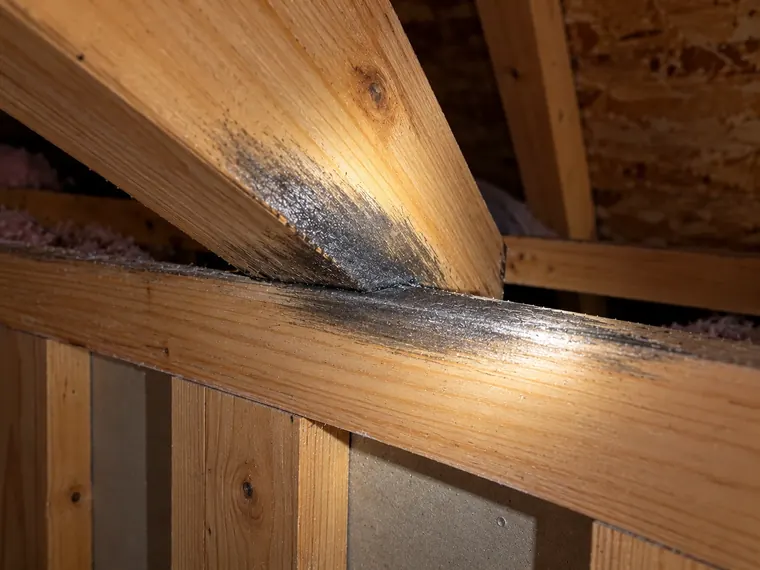
Rub marks are dark, faintly greasy smudges left where an animal repeatedly squeezes past a fixed edge. Rodents prefer to travel with a flank against a surface rather than across open floor, so these marks build up along beams, joists, pipe runs, wall-to-floor junctions, and particularly around the edges of openings. They develop over time, which means a rub mark indicates an established, repeated route rather than a one-off visit.
For locating an entry point, rub marks are the single most valuable sign. A smudge on the underside of a soffit return, around a utility penetration, or at the corner of a gable vent points directly at where the animal is coming and going. If you can see one from a safe position, photograph it and note exactly where it is. An inspector given that information can work backwards from the route to the opening rather than searching the whole exterior.
Gnaw marks and what they signal about urgency
Rodent incisors grow continuously, so gnawing is constant maintenance rather than only feeding behavior. Fresh gnaw marks on wood appear pale against weathered surfaces and have distinct paired grooves; older marks darken and blend in. On packaging, gnawing tends to be concentrated at corners and seams.
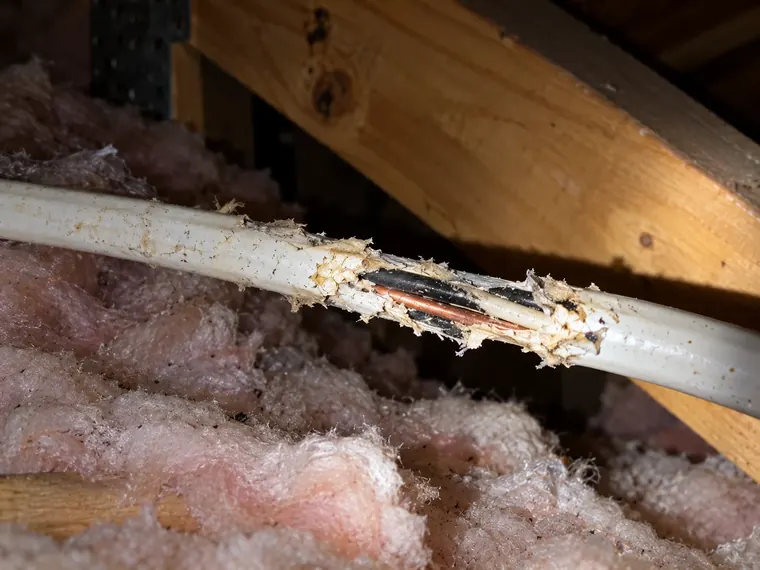
Gnawing on electrical wiring changes the priority. Damaged insulation on a conductor is a fire risk, and it is not something to assess by pulling at the wire or moving insulation to get a better look. If you see chewed wiring, or if you have unexplained intermittent electrical faults alongside other rodent signs, say so clearly when you call, and have the wiring evaluated by a qualified electrician rather than a pest technician alone. Pest control and electrical repair are separate trades and separate scopes.
Signs of rodents in Merritt Island homes that people notice last
Several indicators are easy to dismiss individually and meaningful together. A persistent musky odor that does not resolve with cleaning can indicate accumulated urine and nesting material in a confined space. Insulation that looks flattened, tunnelled, or pulled into a heap suggests nesting rather than transit. Disturbed or shredded paper, fabric, or cardboard in a garage or storage area is nesting material being gathered.
Pet behavior is a genuine early indicator that owners often recognize only in hindsight. A dog or cat that repeatedly fixates on one spot on a ceiling, a wall void, or the back of an appliance is frequently responding to something audible to them and not to you. It is not proof, but combined with any other sign on this page it is worth mentioning during the inspection.
Outdoors, look for worn runways along fence lines, foundation edges, and dense ground cover, and for burrow openings at the base of walls or under slabs. On Merritt Island, also look up: worn paths along a limb that reaches the roof, or scratched bark on a palm, can indicate the approach route. The roof rat control page covers those climbing routes in detail.
What to record before you call
A short, specific set of notes makes the first inspection considerably more productive. Write down when you first noticed anything, what changed since, and whether the activity is increasing. Record the times of day sounds occur, over several days rather than one. List each room where you have found droppings or damage, and roughly how much. Note any recent exterior work, storm damage, roof repair, or landscaping change, because those frequently coincide with a new opening.
Then stop. Do not climb onto the roof, enter a low crawlspace, or open up an attic to gather more evidence. The marginal information is small and the risk is not: unstable footing, damaged wiring, insulation contamination, and in Florida the real possibility of encountering wildlife other than rodents. An inspection is the point at which someone equipped for the space takes over.
Signs that warrant moving quickly
- Visible gnawing on electrical wiring, or unexplained intermittent electrical faults
- Droppings in food preparation or food storage areas
- A strong persistent odor, which may indicate a dead animal in a void
- Daytime sightings indoors, which often suggest an established population rather than a stray animal
- Rapid increase in the amount of evidence over days rather than weeks
Frequently asked questions
How do I tell a rat from a squirrel in the attic?
Timing first: squirrels are active in daylight, rats after dark. Sound character second: squirrel movement is heavier with rolling or dragging noises, rat movement lighter and quicker. Droppings confirm it if they can be observed safely.
Do rub marks mean the problem is old?
They mean the route is established rather than incidental, because the marks build up through repeated passage. They do not date the activity precisely, but they distinguish a regular travel path from a single exploratory visit, which is exactly what an inspector wants to know.
I hear noises but cannot find droppings. Does that rule out rodents?
No. Activity confined to an attic, soffit, or wall void can leave no evidence in living space at all. Droppings in the occupied part of a house indicate the animal is moving through it; their absence simply means it is not, which is useful information rather than an all-clear.
Can I identify the species from the sound alone?
You can usually narrow it to rodent or larger wildlife, and often to nocturnal or diurnal. Confirming roof rat against mouse against something else generally needs physical evidence such as droppings, gnaw dimensions, or rub marks, which is part of what an inspection establishes.
Cleanup precautions on this page follow published CDC guidance on cleaning up after rodents. Gap and identification context draws on UF/IFAS extension material on rat and mouse control in Florida. This page is general information, not a diagnosis of conditions at any specific property.